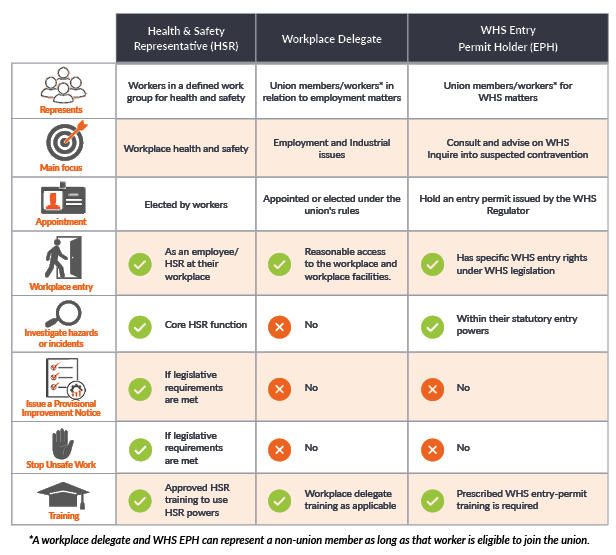
Workplace Representation: Understanding the Difference Between HSRs, Workplace Delegates and WHS Entry Permit Holders
Health and Safety Representatives (HSRs), Workplace Delegates and WHS Entry Permit holders all play important roles in supporting workers, but they have different responsibilities, rights and powers. Understanding the difference can help you know who to approach when you have a workplace concern and what they can do to support you.
HSRs - representing workers on health and safety
HSRs are workers part of a workgroup who represent their workgroup in relation to work health and safety (WHS) matters. HSRs have specific functions and powers under WHS legislation, including functions relating to:
- Conducting workplace inspections and reviewing the circumstances of workplace incidents, hazards and Health and safety complaints.
- Represent workers in their work group on health and safety matters, including accompanying NT WorkSafe inspectors.
- Attend interviews where the worker consents.
- Participate in health and safety committees, including requesting that a committee be established.
- Monitor compliance measures and risks to workers in their work group.
- Exercise specific statutory powers, including issuing a Provisional Improvement Notice (PIN) or directing workers to cease unsafe work, where the relevant legislative requirements are met.
HSRs must meet applicable legislative requirements before exercising certain powers. For example, an HSR must have completed the required training to exercise the power to issue a PIN.
A HSR does not assume overall responsibility for workplace safety. That responsibility remains with the relevant duty holders under WHS legislation.
Workplace Delegate — representing members on employment and industrial matters
Workplace delegates represent and support union members, including workers eligible to join the union, on employment and industrial matters, including in disputes about work.
Responsibilities include:
- Speaking to management on behalf of members and raise workplace issues.
- Help members with concerns, complaints, disputes, rights and entitlements.
- Share union information, represent members’ views, and assist with workplace discussions and bargaining when authorised.
- Supporting workers raising WHS concerns, including helping them access the appropriate representation and support.
A workplace delegate’s rights and responsibilities come from their role as a union delegate and the applicable industrial laws, instruments and union rules. A workplace delegate does not gain HSR powers simply because an issue involves health and safety.
WHS Entry Permit Holders are authorised union officials who hold the relevant statutory permits to exercise specified rights of entry for WHS purposes.
Subject to the applicable legislative requirements, they may enter a workplace to:
- Investigate a suspected contravention of WHS legislation.
- Inspect relevant work systems, plant, structures or other things connected with a suspected contravention.
- Consult with relevant workers and the person conducting the business or undertaking (PCBU).
- Consult with and advise workers on WHS matters.
- Access relevant workplace documents where the legislation permits.
Entry requirements depend on the purpose of the visit. For example, entry to consult with and advise workers generally requires advance notice, while entry to investigate a suspected WHS contravention may be permitted without prior notice, subject to the statutory conditions.
Entry Permit Holders must comply with applicable entry, identification, conduct and other legal requirements.
An entry permit does not, by itself, give its holder the statutory powers of an HSR. A WHS Entry Permit Holder cannot direct work to cease or issue a PIN merely by virtue of holding an entry permit.
Two hats, two roles
One person can wear both hats, but the powers come from the role they are performing. So, it is important they are clear about which role they are performing.
- WHS concern or unsafe work? Your HSR can represent your work group and exercise applicable WHS functions and powers.
- Employment or industrial issue? Your Workplace Delegate can assist.
- Issue involves both? Your HSR and Workplace Delegate may both have a role, working within their respective responsibilities and powers.
A worker may also be supported by a WHS Entry Permit Holder where the relevant entry requirements are met.
Know your rights. Know who can help. Whether it’s a safety concern, workplace issue or both, knowing the right role means getting the right support when you need it. Different roles, different powers—stronger representation for workers.
Practical example — an unsafe machine
A worker raises concerns about an unsafe machine.
- The HSR can represent the work group, investigate the safety concern within their statutory functions and exercise applicable WHS powers.
- The Workplace Delegate can support the worker in raising the concern and address any related employment or industrial issues.
- The WHS Entry Permit Holder may be able to enter the workplace under the relevant statutory conditions to investigate a suspected WHS contravention or consult with and advise workers.
Each role can provide valuable support, but each person must act within the authority of the role they are performing.
Understanding WHS representative roles
How HSR's, workplace delegates and WHS Entry Permit holders differ.